





Jeep’s Resilience: A Legacy of Endurance from Battlefield to Stellantis

Jeep’s story began in the early 1940s, born out of necessity during World War II.
The U.S. Army needed a rugged, versatile vehicle for reconnaissance, capable of navigating tough terrain. In 1940, the Army issued a call for a “light reconnaissance vehicle,” and Willys-Overland, along with Ford and Bantam, answered. Willys’ design, the Willys MB, with its iconic boxy shape, slatted grille, and four-wheel-drive capability, became the blueprint for the modern Jeep. Produced from 1941, over 600,000 units were built, serving as the backbone of Allied mobility in the war. Soldiers nicknamed it “Jeep,” possibly from the Army slang “GP” (General Purpose), though the term’s origin remains debated.
After the war, Willys saw the civilian potential and introduced the CJ (Civilian Jeep) series in 1945. The CJ-2A, with its go-anywhere attitude, laid the foundation for Jeep’s reputation as a symbol of freedom and adventure. Over the decades, Jeep evolved, introducing models like the Wagoneer in 1963, one of the first SUVs, blending off-road prowess with family-friendly comfort.
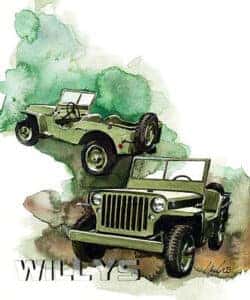 Jeep’s ownership changed hands multiple times, reflecting its resilience amid industry shifts. Willys was acquired by Kaiser Motors in 1953, becoming Kaiser-Jeep. In 1970, American Motors Corporation (AMC) bought Kaiser-Jeep, expanding the brand’s reach with models like the Cherokee. Chrysler took over AMC in 1987, largely to acquire Jeep, which was seen as a gem in a struggling portfolio. Jeep’s rugged appeal kept it thriving while other brands faltered.
The 2008 financial crisis hit Chrysler hard, leading to a 2009 bankruptcy and a partial takeover by Fiat, forming Fiat Chrysler Automobiles (FCA). Jeep’s global popularity, especially models like the Grand Cherokee and Wrangler, was a lifeline, often outlasting weaker models from other brands under the same umbrella. In 2021, FCA merged with PSA Group to form Stellantis, a global powerhouse. Jeep’s enduring legacy, rooted in its wartime grit and off-road DNA, made it a cornerstone of Stellantis’ portfolio, consistently driving sales when competitors’ models faded.

0 comment(s) so far on Jeep’s Resilience: A Legacy of Endurance from Battlefield to Stellantis